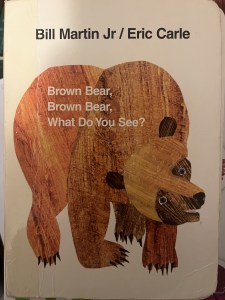
Brown Bear, Brown Bear, What Do You See? is a book that came to me rather than I selected the book. I found this book at the local public library and paid no attention to it. Until I read it to my 2.5-year-old daughter, it unveiled its magic to me. My daughter just loved what seemed to be a quite simple book, and she started to learn to read from the book. This is the first book that led her to read with us and read by herself.
It is a book written by Bill Jr. Martin. I came across illustrations by Eric Carl. Whether you are an educator or a parent, you have definitely heard of Eric Carl and his famous book, The Very Hungry Caterpillar. Who doesn’t have this book at home as a toddler nowadays? Yes, you will find your little one just so familiar with the illustration style and quickly build a connection to this book with their previous reading experiences. But of course, I didn’t read the book just as it was. Using this book with some intentional teaching strategies can help your toddler read and use this book to a wide extent.
Now let’s read and use the book in three different ways and wait for the magic learning result from your child.
Activity1: Read Aloud and Shared Reading (for both educators and parents)
Read-aloud is a common strategy used for teaching reading, which is to demonstrate “modelling reading” for the students (Fellowes & Oakley, 2020). However, with toddlers, this strategy can be suitable for both educators in the early childcare centre and parents. Researchers showed that effective read-aloud strategies can promote a love of literacy for young children (Towell et al., 2019). Toddlers around 18–36 months old love stories with repetitions, and they can participate in reading by pointing at the pictures, making noise about animals, and having their favourite books and tents to listen to the favourites many times (Fellowes & Oakley, 2020). Thus, this activity can be performed within a month or be repeated many times as preferred.
Shared reading is a mimic of parents’ home reading, but with a focus on the concept of print when reading the stories (Fellowes & Oakley, 2020). To achieve the teaching goal, it’s better to have a repetitive structure when selecting the book (Fellowes & Oakley, 2020). This book is just the right one to meet all these requirements. This activity is just an educator- or parent-led reading activity, but a variety of ways of reading this book are provided here.
When to read: before nap or sleep
Times to read: one time
How many kids involved: 1-2
Different ways to read:
- Sing the text to the tune of the first nursery rhyme, Twinkle, Twinkle, Little Star.
- Read the text, make the noise of the animal shown on the page, and imitate the animal as well. For example, the educator/parent can read, “Brown bear, brown bear, what do you see? ROAR! I see a red bird looking at me.” while pretending to be a scary bear, showing its teeth and claws.
- Read the title, point to the comma, and question mark and read them as well. For example, the educator or parent can read, “Brown bear, comma, brown bear, comma, what do you see, question mark.” Then do the same when reading every page. Starting from here, the next time you read, you can ask the child to point out the “eyes” or “nose” of all the objects in the book, to help build up their vocabulary. You can also count all the children in the book whenever you read that page.
- For parents, you can work as a pair to read the book, as the book is written in a question-and-answer style, which can be a perfect way to help your child become familiar with the wh-questions. For instance, one of the parents can read the questions in the book, and the other can read the answers. Then, with the child, you can read the last page, which shows all the objects that appeared in the book together. Starting from here, you can even ask,” Daddy, daddy, what do you see?” And leave the answer to your partner or your kid, they might say,” I see a sleepy mummy looking at me.”
Do remember to make the animal noise and pose throughout the book. And help the child to point to and focus on the animals on each page.
Activity2 Puzzle (For both educators and parents)
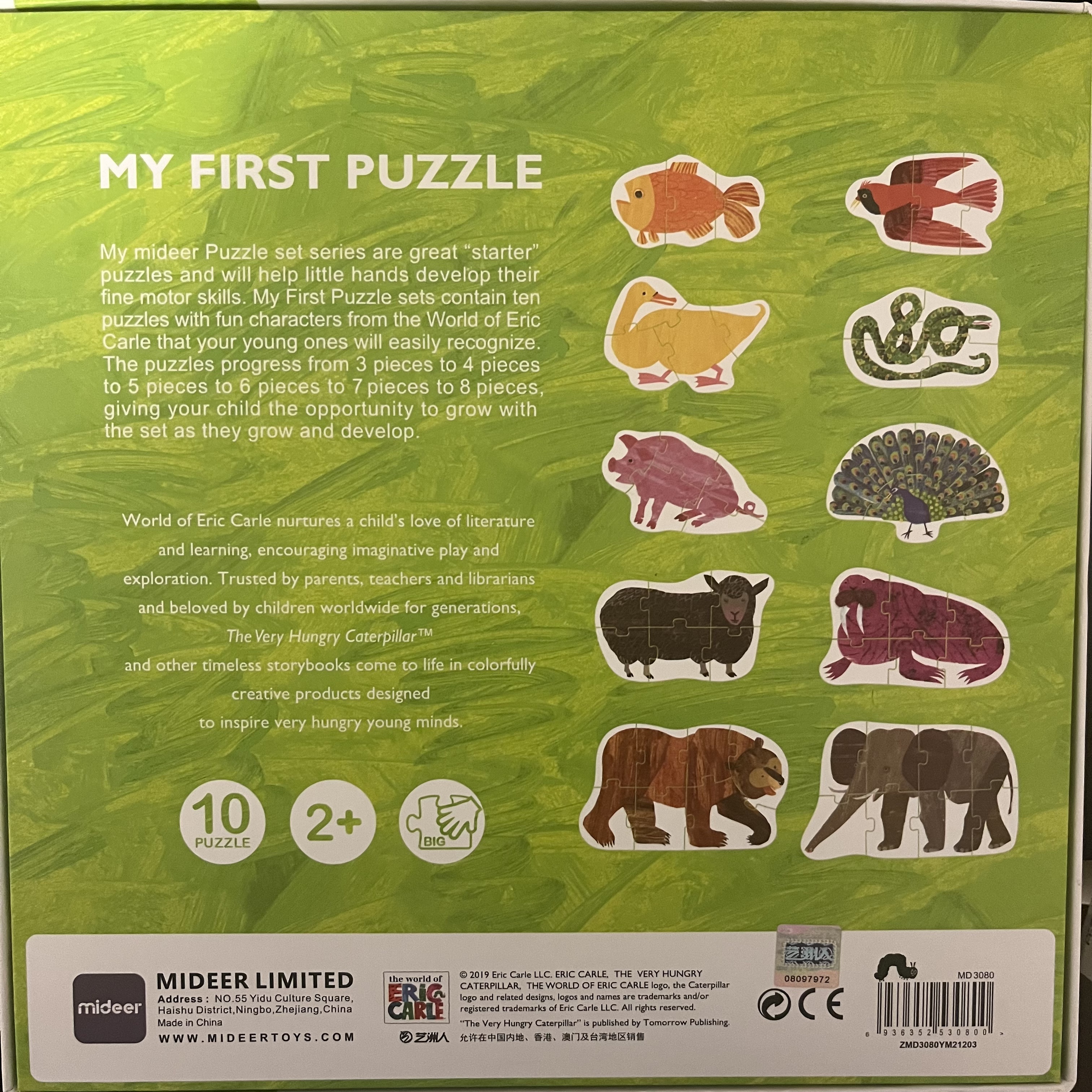
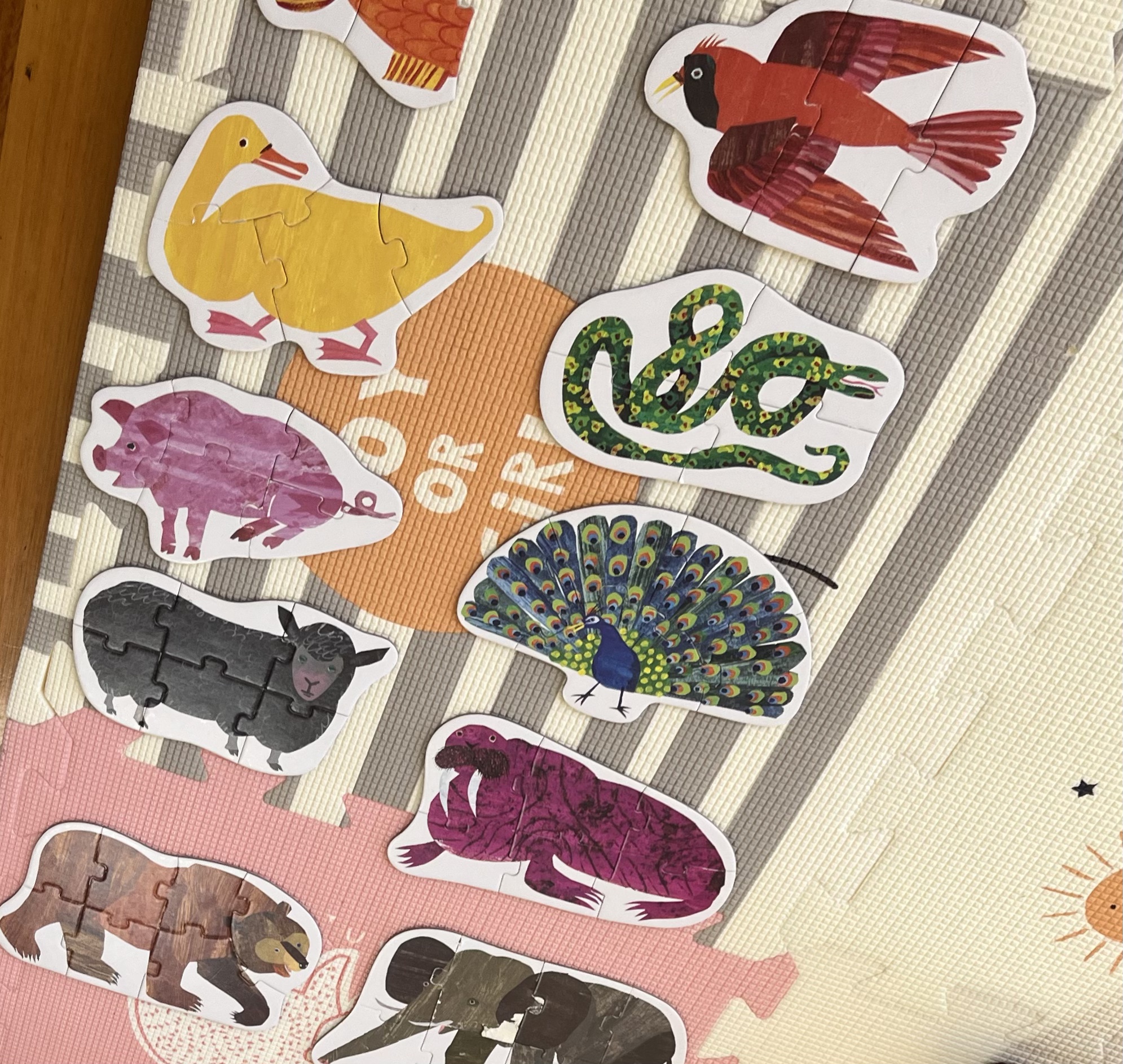
As Eric Carl’s children’s book series is so famous all around the world, it is easy to find story-related products for children. I found a puzzle that is based on the illustration of the book and is perfectly produced just for this age group.
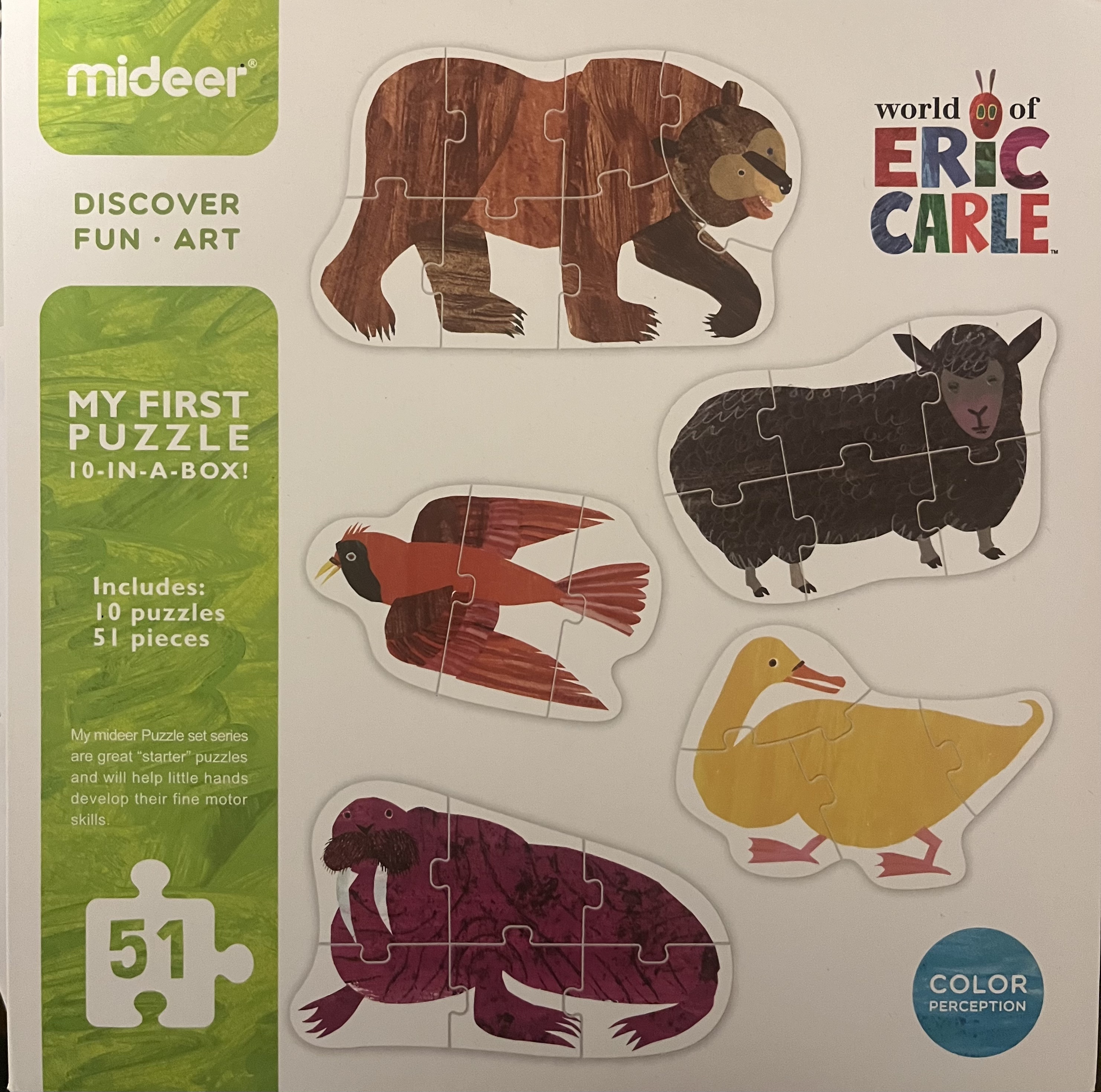
When to do it: after breakfast or morning tea
Time to read: one time
How many kids involved: 1-4
The educator or parent can read the book with a read-aloud strategy to one child or even a small group of children. Then, open the puzzle for the kids to play. While doing this, the educator/parent should provide the book as a reference to help the children work out the puzzle. A series of questions and tasks can be done within this process to create opportunities for the children to practice their oral language.
Task 1: Ask the children to sort out the pieces of puzzles according to colour.
You can ask the student questions about colour in the task.
Task 2: While making the puzzles, ask the students to look at the book as a guide.
You can ask about the different body parts of the animals, the sounds they make, and the names of the animals.
Task 3: After making the puzzles, ask the students to flip the puzzle.
You can ask or read the words written at the back of the puzzles with the children. You can even count how many pieces of puzzles are there with the kids.
Activity 3: Walk outside with the book (for both educators and parents)
As this book includes many commonly seen animals in everyday life, you can take the book with you when you organise the children with an outing activity (for the educators) or just take a walk around your home (for parents). This can also provide many opportunities to improve the child’s oral language skills and to connect the book with a real-world scenario. You may find a bird or a dog and ask the child about the name of the animal, the colour of the animal, and what sounds the animal makes. Then, let the child find the animal in the book and read the book with you. Starting from this point, you can guide the children into the big world around them by asking, for example, “Danny, Danny, what do you see?” You may find the child pointing to one of the objects around him and telling you the name of the object or waiting for you to teach him the name of it. The book is a useful warm-up material for the children to explore and learn the things around them.
Do you know why I recommend this book to you? I did all the activities above with my 2-year-old daughter. This book has stayed her and my favourite night storybook for quite a long time (you’ll find it is one of the best books to read before sleep as the content of it is so simple and very repetitive, it even helps the child to fall asleep). I have to convince you that my daughter gradually learned all the names of the animals from the book and started to call her educator “teacher” after reading the book. She learned to count from 1 to 9 with this book. She started to realise that the words printed on the page conveyed sounds and meaning. Thus, she was thrilled and longed to read by herself. Realizing the question mark showed a question, she started to ask me, “What’s that?” one day. In addition to this, she remembered all the colours in the book and was very quick at sorting and making the puzzles. By making the puzzles, she learned more about the names of the animals.
You don’t believe this? Just have a try!
Great news for the bilingual family! You can find different translated versions of this book based on your language requirements and do these activities in both languages. For example, I also got a Mandarin version for my child!

References
Fellowes, J., & Oakley, G. (2020). Literacy, language and early childhood education (3rd ed.). Oxford University Press.
Towell, J. L., Bartram, L., Morrow, S., & Brown, S. L. (2019). Reading to babies: Exploring the beginnings of literacy. Journal of Early Childhood Literacy, 21(3), 146879841984619. https://doi.org/10.1177/1468798419846199
 BlaBlaMia